Viscosupplementation for Knee Osteoarthritis: How can Hyaluronic Acid injections reduced join pain?

Knee osteoarthritis (OA) is a common and debilitating joint disease that affects millions worldwide. It’s a degenerative type of arthritis where the cartilage, the cushioning and smoothening material between the bones in the joint, wears down, leading to pain, stiffness, and reduced mobility. Early detection and management of knee OA are crucial, as the disease can progress from mild discomfort to severe disability if left untreated. While there’s no cure for OA various treatments are available to manage symptoms and improve quality of life. These range from lifestyle modifications, medication, joint injections and in advanced cases, surgical interventions [1].
For patients who don’t show improvement with oral medications, topical treatments, or physical therapy, doctors may suggest injections directly into the joint. These injections can include:
- Corticosteroids
- Viscosupplements
- Platelet-rich plasma (PRP)
- Stem cells
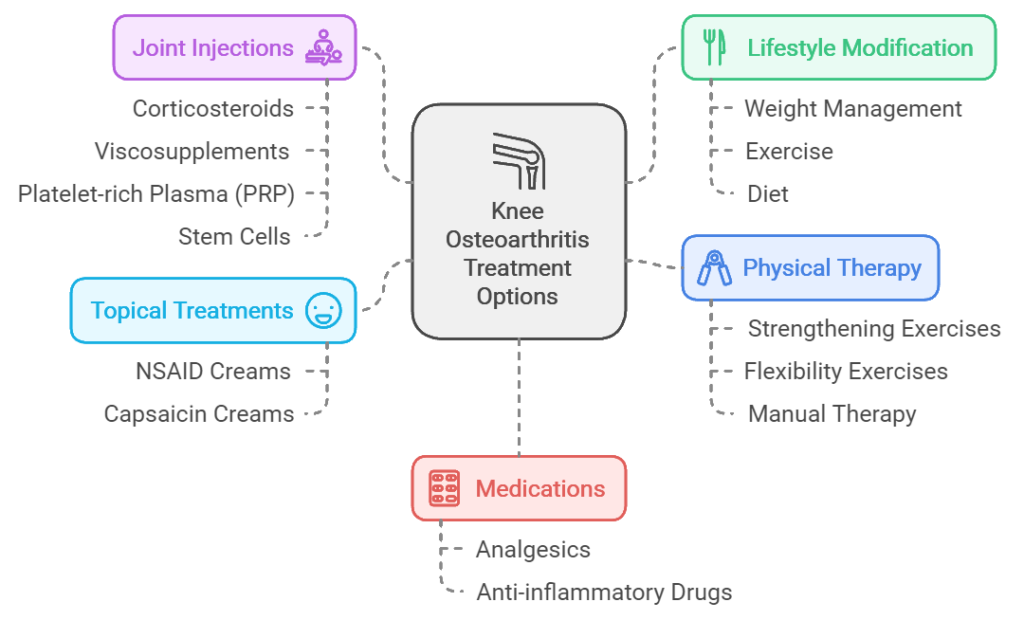
Hyaluronic acid (HA) injections into the knee joint have been a common treatment for knee osteoarthritis symptoms for over 30 years.
What is Hyaluronic Acid, and How Does it Work in the Knee?
Hyaluronic acid is a glycosaminoglycan, naturally found in our bodies, particularly in the synovial fluid that lubricates and cushions our joints. Think of it as the oil that keeps a machine running smoothly! In the knee joint, HA helps:
Reduce friction:
- It acts as a lubricant. HA is naturally found in the knee joint, where it gives synovial fluid its viscoelastic properties. This nature allows HA to act as a lubricant, enabling smooth movement between the bones in the knee joint. During OA, the synovial fluid degrades. This degradation reduces the quantity and average molecular weight of HA. The result is increased friction, leading to pain and difficulty moving the joint.
Absorb shock:
- It helps to cushion the joint, protecting it from impact and wear and tear. The high moisture retention capacity and hygroscopic properties of HA enable it to absorb water and expand, creating a cushioning effect within the joint space. This helps distribute forces and reduce impact on cartilage and bone surfaces.
Reduce inflammation:
- It has anti-inflammatory properties, helping to control inflammation in the joint. Research has shown that intra-articular hyaluronic acid injection encourages synovial fibroblasts to naturally produce HA and components of the extracellular matrix. It also helps protect cartilage by reducing the loss of proteoglycans and preventing chondrocyte cell death. Additionally, HA injections decrease the breakdown of HA by lowering the production of pro-inflammatory cytokines and reduces the production of pain-inducing substances [2].
In people with OA, the quality and quantity of HA in the joint decrease. This contributes to increased friction, inflammation, and ultimately, pain.
Viscosupplementation – The Role of Hyaluronic Acid Injections in Knee Osteoarthritis Treatment
Hyaluronic acid injections, also known as viscosupplementation, involve injecting HA directly into the knee joint. This aims to:
- Replenish HA levels: Restoring the natural lubrication and cushioning of the joint [3], mitigating the effects of HA depletion caused by OA
- Reduce pain and stiffness: By improving joint mechanics and controlling inflammation.
- Improve function: Allowing for easier movement and participation in daily activities [4].
The Benefits of HA Injections: What the Research Says

Hyaluronic acid injections, also known as viscosupplementation, involve injecting HA directly into the knee joint. This aims to:
- Replenish HA levels: Restoring the natural lubrication and cushioning of the joint [3], mitigating the effects of HA depletion caused by OA
- Reduce pain and stiffness: By improving joint mechanics and controlling inflammation.
- Improve function: Allowing for easier movement and participation in daily activities [4].
The Benefits of HA Injections: What the Research Says
A recent systematic review, published in Cureus [3], analysed data from 38 randomised controlled trials conducted between 2015 and 2021. These trials involved over 5,000 patients with knee OA and aimed to evaluate the safety and efficacy of HA injections. Here’s what they found:
Pain relief and improved function:
- The review confirmed that HA injections can provide significant pain relief and improve joint function for up to six months. This can make a real difference in the lives of people with OA, allowing them to engage in daily activities with less pain and discomfort.
Potential disease-modifying effects:
- While more research is needed in this area, some studies suggest that HA injections may have a positive impact on cartilage health, potentially slowing the progression of OA. This is an exciting area of research as it could mean that HA injections might offer more than just symptom relief.
Safe and effective:
- HA injections are generally safe and well-tolerated. While minor side effects like local pain and swelling are possible, these are typically short-lived. Severe allergic reactions are extremely rare.
In an earlier review of literature, published in Seminars in Arthritis and Rheumatism in 2019 [2], Bannuru et al. concluded:
“Thus, we conclude that intra-articular hyaluronic acid is a valuable tool in the treatment armamentarium alongside other pharmacologic and non-pharmacologic treatment options and should not be disregarded.”
How long do the injections last? Duration of Pain Relief from Hyaluronic Acid Injections
The improvement in pain from intra-articular injection of hyaluronic acid typically lasts for several weeks and can extend up to six months
The meta-analysis by Bannuru et al. found that hyaluronic injections reache peak effectiveness at 8 weeks and can exert residual effects for up to 24 weeks [2]. A cross-sectional study found the mean duration of effectiveness of viscosupplementation to be 48 weeks, with a range of 0-156 weeks [5].
Factors Influencing the Effectiveness of HA Injections
While several review confirm the benefits of HA injections, it’s important to note that their effectiveness can vary. This can be influenced by several factors, including:
- Severity of OA: The benefits of HA injections may be more pronounced in people with mild to moderate knee OA.
- Molecular weight and formulation: High molecular weight HA preparations tend to show better results compared to low molecular weight options. Additionally, cross-linked HA formulations might have advantages over avian-derived HA.
- Individual patient factors: As with any treatment, individual responses to HA injections can differ. Factors like age, overall health, and the presence of other medical conditions might play a role.
- Body mass index: The role of body weight on the duration of pain relief following HA injections was highlighted in a different review by Rapp et al. [5]. They concluded that being overweight shortens the duration of pain relief one can expect from an HA injection.
Key Takeaways: Hyaluronic acid Injections in the Context of Knee OA Treatment
Recent systematic reviews, along with the wider research on HA, provides valuable insights into the role of HA injections in treating knee OA:
- Not a first-line treatment: HA injections are generally recommended for people with mild to moderate knee OA who haven’t experienced sufficient relief from conservative treatments like oral medications and physical therapy and lifestyle modification.
- Part of a comprehensive treatment plan: HA injections should be seen as one component of a multi-faceted approach to managing knee OA. This often involves a combination of:
- Lifestyle modifications: Maintaining a healthy weight, regular exercise, and using assistive devices when needed.
- Pain management: Using over-the-counter or prescription pain relievers.
- Physical therapy: Strengthening muscles, improving joint stability, and increasing range of motion.
- Individualised approach: The decision to use HA injections, and the specific formulation chosen, should be made in consultation with a healthcare professional, taking into account the individual’s needs and preferences.
While HA injections offer a potential avenue for pain relief and functional improvement for those living with knee OA, it’s essential to remember that their effectiveness can vary. Continued research into HA’s potential disease-modifying effects and combining it with other therapies holds promise for even better outcomes in the future. and combining it with other therapies holds promise for even better outcomes in the future.
References
[1] V. B. Vad, D. R. Adin, and J. Solomon, “Knee Osteoarthritis,” Crit Rev Phys Rehabil Med, vol. 16, no. 3, pp. 211–231, Jun. 2023, doi: 10.1615/CritRevPhysRehabilMed.v16.i3.30.
[2] E. Maheu, R. R. Bannuru, G. Herrero-Beaumont, F. Allali, H. Bard, and A. Migliore, “Why we should definitely include intra-articular hyaluronic acid as a therapeutic option in the management of knee osteoarthritis: Results of an extensive critical literature review,” Semin Arthritis Rheum, vol. 48, no. 4, pp. 563–572, Feb. 2019, doi: 10.1016/J.SEMARTHRIT.2018.06.002.
[3] S. Chavda, S. A. Rabbani, and T. Wadhwa, “Role and Effectiveness of Intra-articular Injection of Hyaluronic Acid in the Treatment of Knee Osteoarthritis: A Systematic Review,” Cureus, vol. 14, no. 4, Apr. 2022, doi: 10.7759/CUREUS.24503.
[4] J. Peck et al., “A Comprehensive Review of Viscosupplementation in Osteoarthritis of the Knee,” Orthop Rev (Pavia), vol. 13, no. 2, 2021, doi: 10.52965/001C.25549.
[5] C. Rapp, F. Boudif, C. Bourgoin, A. Lohse, and T. Conrozier, “A Cross-Sectional Study of Factors Predicting the Duration of the Efficacy of Viscosupplementation in Knee Osteoarthritis,” J Clin Med, vol. 13, no. 7, Apr. 2024, doi: 10.3390/JCM13071949.